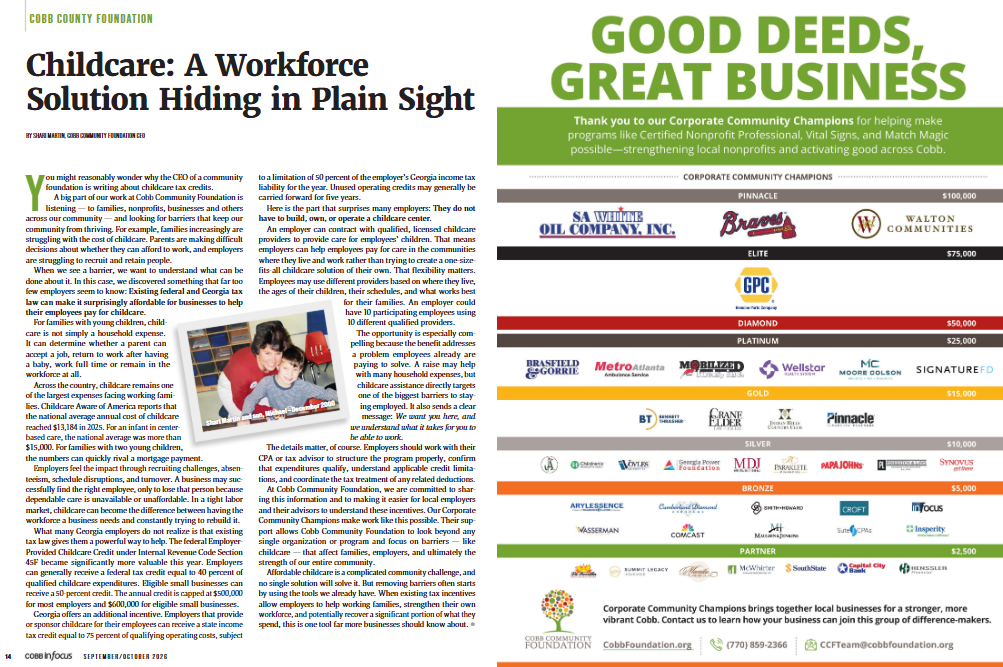
The following article originally appeared in the September/October 2026 issue of Cobb In Focus and is republished here with permission.
 Read the original feature in Cobb In Focus by Cory Sekine-Pettite here (pg 14).
You might reasonably wonder why the CEO of a community foundation is writing about childcare tax credits.
A big part of our work at Cobb Community Foundation is listening—to families, nonprofits, businesses and others across our community—and looking for barriers that keep people and our community from thriving. Increasingly, childcare is one of the barriers we hear about. Families are struggling with the cost. Parents are making difficult decisions about whether they can afford to work. And employers are struggling to recruit and retain the people they need.
When we see a barrier, we want to understand what can be done about it. And in this case, we discovered something that far too few employers seem to know: existing federal and Georgia tax law can make it surprisingly affordable for businesses to help their employees pay for childcare.
For families with young children, childcare is not simply a household expense. It can determine whether a parent can accept a job, return to work after having a baby, work full time or remain in the workforce at all.
Across the country, childcare remains one of the largest expenses facing working families. Childcare Aware of America reports that the national average annual price of childcare reached $13,184 in 2025. For an infant in center-based care, the national average was more than $15,000. For families with two young children, the numbers can quickly rival a mortgage payment.
Those costs create difficult choices. A parent may reduce hours because the added income from working full time barely covers additional childcare. Another may turn down a promotion because the schedule no longer works with available care. Some leave the workforce altogether.
Employers feel the impact through recruiting challenges, absenteeism, schedule disruptions and turnover. A business may successfully find the right employee, only to lose that employee because dependable care is unavailable or unaffordable. In a tight labor market, childcare can become the difference between having the workforce a business needs and constantly trying to rebuild it.
What many Georgia employers do not realize is that existing tax law gives them a powerful way to help.
Beginning in 2026, the federal Employer-Provided Childcare Credit under Internal Revenue Code Section 45F became significantly more valuable. Employers can generally receive a federal tax credit equal to 40% of qualified childcare expenditures. Eligible small businesses can receive a 50% credit. The annual credit is capped at $500,000 for most employers and $600,000 for eligible small businesses.
Georgia offers an additional incentive. Employers that provide or sponsor childcare for their employees can receive a state income tax credit equal to 75% of qualifying operating costs, subject to a limitation of 50% of the employer’s Georgia income tax liability for the year. Unused operating credits may generally be carried forward for five years.
Here is the part that surprises many employers: they do not have to build, own or operate a childcare center.
An employer can contract with qualified, licensed childcare providers to provide care for employees’ children. That means employers can help employees pay for care in the communities where they live and work rather than trying to create a one-size-fits-all childcare solution of their own.
That flexibility matters. Employees may use different providers based on where they live, the ages of their children, their schedules and what works best for their families. An employer could have ten participating employees using ten different qualified providers—and that can work.
A company might decide to contribute $200, $400 or more each month toward childcare for participating employees. For a parent facing a significant monthly childcare bill, that assistance can be meaningful. For the employer, the federal and Georgia tax credits can substantially reduce—and in some circumstances potentially more than offset—the cost of providing the benefit.
The opportunity is especially compelling because the benefit addresses a problem employees are already paying to solve. A raise may help with many household expenses, but childcare assistance directly targets one of the biggest barriers to staying employed. It also sends a clear message: We want you here, and we understand what it takes for you to be able to work.
The details matter, of course. Employers should work with their CPA or tax advisor to structure the program properly, confirm that expenditures qualify, understand applicable credit limitations and coordinate the tax treatment of any related deductions.
But this is not an obscure tax strategy available only to large corporations with on-site day care. It is a practical tool that businesses of many sizes can use.
At Cobb Community Foundation, we are committed to sharing this information and to making make it easier for local employers and their advisors to understand these incentives and put them to work. Our Corporate Community Champions make work like this possible. Their support allows Cobb Community Foundation to look beyond any single organization or program and focus on barriers—like childcare—that affect families, employers and ultimately the strength of our entire community.
Affordable childcare is a complicated community challenge, and no single solution will solve it. But removing barriers often starts by using the tools we already have. When existing tax incentives allow employers to help working families, strengthen their own workforce and potentially recover a significant portion of what they spend, this is one tool far more businesses should know about.

Photo: Shari Martin and son, Michael – December 2000